Showing posts with label reading. Show all posts

Tuesday, December 31, 2013

Tidings of comfort and joy

Merry Christmas and Happy New Year! This advent season, I wanted to impress on B the true meaning of Jesus' birth and how it is not just about gifting but also the act of giving, and God's ultimate gift of life. Although it was hard to break free from all the commercialism, we found a few simple ways to reflect this while still doing our fair share of Christmas mall hopping :)

We made an advent calendar from B's artwork with clear plastic pockets to mark the 24 days, which was December 1 to 24 this year. I liked how this simple template could be re-used many times for things like learning numbers, letters, words, days and months, etc. Each day, we prayed for specific family, friends, those in need, our country and world, ending with the fruits of the spirit -- which B coincidentally learned in Sunbeam (Sunday School) year. On Christmas morning, we visited a single mother of 5 kids as part of our church's community blessing project before joining our cell group for food and carols. I look forward to more fun, faith-based activities as he grows up. For 2014, we could try this weekly series based on proverbs, more on the fruits or even try working through this catechism as our church's awesome new Devotional Journal weekly family section doesn't quite work for young tots.

Of course, we also covered the usual Christmas craft and books. Between work, colds, family visits, playdates, parties and our year end holiday to Hong Kong, we couldn't complete a nativity project or join many church events. After reading some books and our toddler bible, B recalls the nativity story by acting out a pregnant mama (Mary), old hunched men with presents (three wise men) and a wailing baby (Jesus).... It's a start I guess ;)

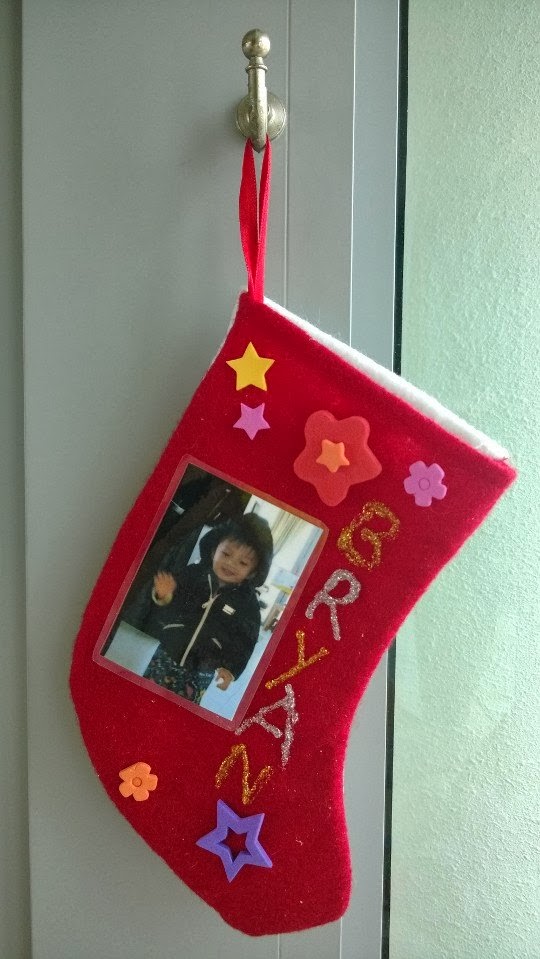
As for craft, this time around I let him try cutting, gluing, threading (punched holes around the art), and letter tracing (glued glitter on words).  We started with a Christmas star for the tree, stockings and poinsettas. We used the remaining painted rolls to make a turkey for a friend's Thanksgiving dinner. 
Wreath with holly, berries and gingerbread men
(Grandma made those cute origami mini-Santa Clauses)
Sticking ornaments on a car track painted Christmas card for his cousin

Home-made watercoloured ornaments :)
Rudolph the red nosed reindeer 
 
B in a snow globe
Collage art of peace, love and joy - the last 3 days in our advent calendar

Turning 2 has been a tipping point with some of the worst and best developments to date. B started shrieking for attention, tipping over his bowl/plate/cup when almost done (sooo annoying!), had bouts of skipped naps, early waking and general crankiness throughout the day. On the plus side, his interest in print (numbers and letters) keeps growing. He correctly spells out most words in big letters, is getting better at small letters, loves counting as well as spotting numerals. To my delight, soon after his birthday, he finally started singing. In tune! All the time! What was previously a monotone rap transformed into spontaneous singing and dancing to favourite songs and those he hears often (i.e. Jingle Bells). I even caught him singing nursery songs that I used to hum to him as a baby. Quite amazing what our kids retain at this age!

This Thursday, B will start half-day nursery, with mommy joining for a few hours/days before transitioning to a complete drop-off. I got him a personalised preschooler book, and also printed out photos of his new school to add to our scrap book to get him familiar with the concept.  It's encouraging that the school also focuses on being global citizens, i.e. donating for charity and recycling for art.  Here's hoping B's new journey with Odyssey will be even more rewarding and fun than it's been with mommy and me so far.

Want to receive updates, reviews and more? Like me at Finally Mama on Facebook

Friday, December 6, 2013

To add a library to a house is to give that house a soul

Lately, B spontaneously calls out letters he recognises and sometimes sings the A-B-C Song while he pretends to "read" the print. Looks like he's taking the next step to read WORDS on his own initiative, and not just recite from memory, vocalise or narrate what he sees. What a nice milestone for our brand new 2 year old :) B's also developed a list of places to ask for when we're getting ready to go out. To my secret bookworm delight, we hear "go library and read book" almost every other day! Other regulars include "Bus stop and MRT?", "play outside, playground, park", "Botanic Gardens" (where he likes feeding the fish), "ama 公公", "爷爷 奶奶" and his buddies' "house", "buy food at Fairprice" (we grocery shop together a lot), "ride toy car/train at shopping mall", "music" and "Chinese class" (i.e. Kindermusik, Jiggle Wigs, Chengzhu). It's encouraging to see all the time and effort in immersing him in a print and word-rich environment paying off - from getting his first library card at 7 weeks (!), daily newspaper browsing and storytimes, thematic flashcards if he wants to, and just when we relax, chat and read quietly together.

We couldn't have done it without the network of public libraries in Singapore, notably the Bishan, Toa Payoh and Central NLB branches. The breadth and depth of parenting, baby and preschool books to toddler/family friendly activities is amazing AND free (or reasonable enough if you're a foreigner). B's been exposed to a wider range of authors, formats, topics - in both English and Chinese - than I ever was at his age. The books expand his vocabulary and imagination, plus save us money and reduce clutter with more informed buying (i.e. the read-everyday or hard-to-find ones) mainly online via The Book Depository, Fishpond or at the local Popular bookstore. 

Last, a shout out to Fun With Tots, an ongoing series of six library workshops on print motivation, print awareness, phonological awareness, letter knowledge, narrative skills and vocabulary.  I didn't know what to expect when I signed up with B, but was pleasantly surprised by the dedication of each of the librarians who prepared a handout of notes/resources and facilitated their topics with songs, books, parent/caregiver tips to keep everyone from adults to the little tots engaged. Even though it was close to bedtime (8p), B enjoyed each session and would say "go library at night"!  The only disappointment was that so few folks attended. It's ironic that parents prefer to spend money (sometimes up to ~$50-$100 per session) on enrichment classes based on early childhood experts, but can't make time to visit the library or attend a hands-on workshop together (which BTW, costs $2 per 30 min session). Even if our kids attend daycare or preschool, or we work full time, we should still actively participate in fostering a love of reading, a thirst for knowledge and the capacity to imagine in our kids. Seeing is doing and believing. My dad was dubious when I wanted to borrow books on space for B ... who liked it so much that he could eventually name or describe all the planets in the solar system!

SO.... Head on over to your neighbourhood library and browse/borrow some books for the holidays.  You can also find out what's going on at Bounce, the NLB channel dedicated to kids 0 to 12.  BTW, if like B, your kid is just learning his letters and enjoys music, take a look at all these alphabet songs and see what works best!


"The more that you read, the more things you will know. 
The more you learn, the more places you'll go." 
- Dr. Seuss, "I Can Read With My Eyes Shut!"

Sunday, September 1, 2013

No time for flashcards?

This month, we covered TIME.  Thankfully, I managed to save time (hah!) searching for, making and adapting material for B as the theme coincided with the Gymnademics weekly home material.  It allowed us to reinforce numbers as B's been sporadically saying 0 to 20 (in English) and 1-10 (in Chinese). We also dived into the concept of day and night, seasons and weather patterns as B loves pointing to the moon, sun, stars, rain, clouds, etc. ;)

Books. There are soooo many good books about time, numbers and weather. Reading books is even more fun now that he repeats most words and memorises familiar phrases that he likes. Here's what worked well for us among the titles we could find in the library and had at home.


BTW, we really enjoyed "Only My Mom and Me" by Alyssa Satin Capucili which covers the days/seasons that a mom and child spend together.  But I had to return it to the library and haven't bought it online yet :(  Also, there's many book-based activities from Margaret Wise Brown's "Goodnight Moon," a classic bedtime fave that shows how time passes before bed. Maybe we'll try that in Sept....

Craft. We made a weather/week/time wheel to complement the theme.  B loves spinning it while saying the words and numbers. He's also slowly learning how to manipulate the wooden clothespegs. 

Music and Movement. When we reviewed the days and months, B would get stuck on Wednesday and had a tough time associating the months with "concrete" things.  These music videos helped! (Note: There are many out there online, these were the ones we liked more)  
  
Chinese?! One day, B re-discovered our stash of bilingual flashcards, gleefully exclaimed "WOW!" and brought them over to read together.  Whenever there's time at home, he would open box after box to flip through. I try not to repeat the cards and end leaving him wanting more.  He tends to say the English word when he sees/hears me read out Chinese characters, but he does vocalise some Chinese, esp. those he hears frequently from songs, conversations and his first set of Chinese storybooks.  


Art:  Since this was mommy's first year as a Singaporean, we hosted a casual National Day BBQ, jet flypast and fireworks watching at our place. B excitedly says "boom boom fire" and "zoom zoom airplane" when he sees his artist impression proudly displayed on the art wall :)


Outings and Special Projects: This month, B visited Megabugs Return! and the Science Center (rather underwhelming, seriously in need of upgrading), the Art Garden @ SAM (again!) and the Istana Open House for Hari Raya and National Day. We also returned to the Esplanade for Hello Ling, the second in the PLAYtime! series, which dramatised the effects of light or in B's words "sunlight, starlight, moonlight ... and rainbows!" To cap it all, B made his first (?) science discovery, i.e. a simplified "taugeh" project to grow green bean plants over time (i.e. the 7 days in a week) with the help of water, air and sunlight.

Personal:
- When asked "What's your name?"  He'll say it all in one run-on word "bwxy!"
- Mr Manners. B calls "Hi, Thank You, Please, Good Morning, Bye, Day, Night (and Sleep Tight)" if prompted though once in while we'll get a spontaneous "Morning/Bye uncle/aunty!" while in the lift, charming our neighbours (and some strangers). The family tree will come in handy for those Chinese titles and names!
- Potty training steps.  B regularly voices when he needs to pee and poop, does it in the toilet more often and has fewer accidents. Even though we've not yet gone all-in (i.e. he wears diapers/trainers when sleeping and when outside for extended periods), this has been so encouraging for us all. Yes!
- Hello, tantrums. Our gentle, observant 21 month old B has finally succumbed to his undeveloped cortex :) Thankfully the tantrums are not frequent and rather predictable (i.e. he'll say "No like! No want!" or throw a fuss when he's upset, tired at end of day or had a poor nap, or wants to be independent).  I guess a happy, stimulating and secure environment with a balance of love and discipline is no longer enough at this age! B needs his autonomy, and we should “never help a child with a task at which he feels he can succeed.”  Maria Montessori said this best
- Gimme freedom! That's perhaps why B likes music and movement so much.  I flip through the newspaper with him in the mornings, let him choose how many and which books to read, have regular messy, art and music playdates.  As his vocabulary expands, he's forming more and more 2-3 word phrases to better express himself and is gradually overcoming his shyness to say words in Chinese and Malay too 

"Today is Monday" everyday according to B, and it's a delightful day!

Thursday, July 4, 2013

You can never talk too much ... to your kid

I just finished Jill Stamm's "Bright From The Start" and was encouraged by her section on how live, repetitive interaction boosts early language development. Language development begins in utero.  Understanding its use begins as infants interact with family and caregivers, while language acquisition explodes by the time they're three years old. Babies are born physically equipped to hear distinct language sounds (phonemes). By age one, they tune out words not frequently spoken around them, which in turn, they cannot easily pronounce.  In fact, normal and deaf-signing toddlers go thru similar language development milestones: 1st word (11-14 mos), two word combos (16-22 mos), complex rule-driven communication by 3 years on.  While the ability to read early is not consistently linked to advanced intellectual performance later in a life, it's increasingly necessary to excel in local school, and thus, influence self-esteem et al.

Live, repetitive interaction is not about putting a CD, radio or video on constantly nor about having a non-stop verbal diarrhea with your child.  Rather: 

0-6 mos: 
  • Use intentional parentese to stimulate brain and extend attention span
  • Speak Multi or Bilingual naturalistically, preferably with dedicated caregivers or playdates
  • Engage him face to face at an appropriate distance, use music, hang photos, selected mobiles
  • Lap read! Enables a visual embrace as you and child are looking at the same object.  Start short (5 min) but frequent, 4 mos on when visual acuity improves and he can reach out to see and touch objects/pages
6-18 mos: 
  • Deliberately point and label objects by name (light, door), attributes of objects, highlighting ones that are same or contrasting ( smooth, rough, big, small, square, round, blue, red), feelings (tired, hungry, happy)
  • Read over and over!  Hold him close, let him turn pages randomly and be hands on (fine motor skill practice). Modulate voice and facial expressions, even use props to invite participation. Vary intonation to match enthusiasm, emotion, meaning.  Intro simple books with 1-2 sentences per page and plenty of rhythm, rhyme, repetition, rhyming songs, and random play with rhyming words. Knowledge (i.e. retention) generally kicks in after two weeks of repetition
  • Talk frequently! Describe actions and objects. Positive tone, conversational interactions. 
18-36 mos:
  • Dialogic reading: Read with children while engaging them throughout.  Describe the illustrations (where's the frog, how many), describe what they think is happening, predict what might happen next (what's he doing, where's he going), personalise ideas (remember the frog at the park?), share feelings about things in the story, leave lines incomplete -- let them fill in the blanks!
  • Start simple music lessons (keyboard, violin, percussion). Sing fave songs esp with actions
  • Follow tots lead on interests and expose them to environmental print (EP). Read all around you, ask open ended questions. Differentiate printing vs pictures vs sounds that describe them
3 years on: Phonemic awareness (ability to hear beginning, middle and ending sounds), Phonics (linking sounds to letters) and EP recognition evolves by then too.  
Choose books that match your child's brain level of engagement.  Stages of a reader (based on cognitive development):
  1. Attends to pictures, doesn't form stories - picture/photo books, flash cards
  2. Attends to pictures, forms oral stories - creates own story across the pages with "nonsense talk" - listener has to see pictures to follow along 
  3. Attends to pictures, forms written stories - spoken words and intonations sound like reading 
  4. Attends to print - recounts and retells stories they already know while pointing to the print rather than pictures, not actually "reading" 
Recommended tot books (the list is endless, here's a few from her book)
  1. Interactive/lift the flap - Dr Seuss, Margaret Wise Brown, Karen Katz. Baby Dance (Taylor, A). Fit-A-Shape: Shapes.  Where's My Fuzzy Blanket (Carter, N). Wheels on the Bus (Stanley, M). Touch and Talk: Make Me Say Moo (Greig, E). Quack Quack, Who's That? (Noel, D). 
  2. Emotions: Winnie the Pooh: Feelings (Smith, R).  WOW! Babies (GEntius). Faces (Miglis, J). Baby Faces (Miller, M). Where the Wild things Are (Sendak, M).  Alexander and the Terrible, Horrible, No Good, Very Bad Day (Viorst, J).  The Selfish Crocodile (Charles, F). Glad Monster, Sad Monster: A Book About Feelings (Emberley, E). No David! (Shannon, D)
  3. Rhyme & Rhythm: Dr Seuss, Margaret Wise Brown. Each Peach Pear Plum (Ahlberg), Moo, Baa, La La La (Boynton). Five Little Ducks (Raffi). Five Little Monkeys (Christelow). This Old Man (Jones). The Itsy Bitsy Spider (Trapani). Find the Puppy (Cox)
  4. Scribbling (Pre-Drawing/Writing):  Crayon World (Santomero), Figure Out Blue's Clues (Perello). Blue's Treasure Hunt Notebook (Santomero). Harold and the Purple Crayon (Johnson). Get in Shape to Write (Bongiorno). Messages in the Mailbox; How to Write a Letter (Leedy)
  5. EP books: Cheerios Play Book (Wade).  M&Ms Counting Board book (McGrath). Pepperidge Farm Goldfish Counting Fun Book (McGrath). Kellogg's Froot Loops (McGrath).  Sun Maid Raisins Playbook (Weir).  Oreo Cookie Counting Book (Albee).
  6. Helping Young Children Learn Language and Literacy: Birth Through Kindergarten (Vukelich, C. Christie, J. Enz, BJ)

Tuesday, February 19, 2013

Zoo-phonics makes ABCs fun

I'd been meaning to try both phonics as well as whole words with B, regardless of the ongoing debate. Besides daily reading, we started regular flash cards (real images, Doman style) with words spoken in English and Chinese after he turned one.  This has improved B's focus and vocabulary (or at least his comprehension since he's hardly a talking encyclopedia!).  However after several alphabet attempts, the latest being Dr Seuss's ABC: An Amazing Alphabet Book, I realised B needed something more "whole brain" to connect the abstract letters with concrete words.  By chance, we stumbled upon Zoo-phonics when a friend passed us her son's used cards. I decided to give it a try after researching online and seeing this method adopted in Singapore (e.g. Growing Up Gifted includes it in their enrichment curriculum from infant to kindy).  If B remains interested after we run through all 26 lower case merged animal letters (!), I might get the full essential pack.  For now, here's what we're doing and why.

Zoo-phonics was developed in the mid 1980s by Charlene Wrighton and Gigi Bradshaw, two teachers in Northern California, who developed a strong phonics and physical component to enhance the existing whole language methods. Zoo-phonics introduces the alphabet as one thing with 26 parts via a multi-sensory approach involving 
the whole child, eyes, ears, mouth, mind and body. 
  • Endearing animals as letter shapes (visual learning) - Shows animals in the shapes of lowercase letters before teaching the actual letters for easy remembering.  Lowercase letters are taught before capital letters as it's easier for a young child to form a lowercase letter and 95% of reading materials are in lowercase anyways.  In addition, when you flip the Animal Letter Cards around, a "bear" is always a bear but a "b" can easily be a "d" "p" or "q." 
  • Sounds and songs (auditory learning) - Teaches sounds of the letters through the animal names ("a" as in Allie Alligator, etc.), and letter sounds are taught before letter names.  The sound of each letter comes through the initial sound of the animal name. 
  • Hand and body motions, games and activities (kinesthetic learning) - Introduces a body signal to represents each animal letter, which in turn helps them lock in the learning.  Children decode letters (read) and encode letters (spell and write) all at once to songs and what looks like dancing, sucking the stress out of building phonemic awareness.   
For 1-2 year olds like B, Zoo-phonics is taught via music and movement, animals and nature, all which he truly enjoys.  According to them, parents can start as soon as your child is ready to sit for a few minutes and listen to a story.  Teach the individual letter shapes and sounds of the lowercase alphabet with the Animal Letter Cards and Body Movements, which will lay the foundation for all future reading, spelling and writing.  Show one Animal Letter Card at a time then reinforce all the letters you have taught previously with the fun games and activities.  Leave the Animal Cards where your child can find them easily and play with them daily!   

Tuesday, October 30, 2012

Month 11 Week 2: How To Multiply Your Baby's Intelligence

I have never let my schooling interfere with my education. - Mark Twain
There are only two lasting bequests we can give our children. One is roots, the other wings. - Hodding Carter

It took 3+ hours to curl my hair (after 5 years!) so I managed to finish Doman's book on "How To Multiply Your Baby's Intelligence" as I'd been curious about their approach since that Gymnademics trial class.  Stuff that got me thinking below.

Why start now vs wait for formal school (primary at 6 or nursery/kindergarten at 3)
  • Learning begins from birth
  • The brain grows the most at the early stages
  • The first six years are the genesis of genius, limited only by how much material babies get to learn and how it's presented
  • All significant brain growth is finished by six years with growth in ability dropping sharply each year
  • See this recent article on how frequent, positive stimulation can make a big difference in the early years 
  • What we do not use, we lose - the human brain has the memory capacity to hold ~3 million hours of TV shows :).  What are we filling ours with? 
    • Input: see, hear, touch, smell, taste
    • Output: mobility, language, manual competence
  • When "teaching," have fun. Tell your kid how great he is, how much you love him ... often!  
How to teach your baby to read:
  • Only humans can read
  • Words must be large, clear, repeated enough, presented enthusiastically
  • The more speed, the more new material, the more joy, the better
  • Suggested sequence: Commonly used words, self/body, home objects, baby's possessions, foods, animals, actions, colours, modifiers (pairs, opposites), x is a/an/the y z (e.g. "Mango is a sweet yellow fruit") 
  • Suggested approach: Start with 25 words - 5 new ones 3x/day, mix order. Remove one word/day after 1 week. 5 steps: Single words => couplets => phrases => sentences => books
  • Note: I'm already reading books and flashing words with B but like the sequencing and approach which makes more sense than following the alphabet.  After all, what does "A" or "Z" really mean?!
How to teach your baby encyclopedic knowledge;
  • Suggested approach: Show 10 cards, 10 sec, 3 consecutive days. Intro related facts and sub-categories, list 1 to 12 magnitude of knowledge, expande on sub-categories
  • Suggested categories: biology, history, geography, music, art, math, human physiology, general science, language, literature
  • Note:  Instead of following Doman's (excessively) detailed "bits of knowledge" specs, I may start a digital catalog instead (on iPad/Windows 8 tablets?). This is environmentally friendly, cost efficient with unlimited capacity given the ample real-life beautiful pictures and facts available online
    How to teach your baby math
    • Intro with the facts vs intro "laws" i.e. numerals and symbols
    • Science = branch of knowledge dealing with a body of facts systematically arranged to show the operation of laws
    • Suggested 5 step approach:
    1. Quantity recognition: Use dots and patterns to intro 1 to 20
    2. Equations: Demonstrate additions, subtractions, multiplication, division
      1. Using the same dots, illustrate +, -  and x first
      2. Intro 0 - shift similar quantity dots around (e.g. 5 dots + 0 = 5 dots)
      3. Intro up to 100 (does not have to include all numbers from 20 on)
      4. Illustrate / division
    3. Problem solving: Offer choices, sequencing (e.g. 1, 3, 5, 7), greater less than scenarios
      1. Doman's overall approach is that teaching/learning should be fun and testing should be limited to games or real-life evidences
      2. Even if they get it wrong, your response should be along the lines of "Good try, that's actually X, this is Y"
    4. Equalities: Intro (in)equalities, fractions, simple algebra 
    5. Numeral recognition: FINALLY, digits (numbers) as we know them!
      1. Use equalities to show 0-20, mix up the order of dots and numerals 
      2. Intro 1-100 and go beyond 100s
      3. Proceed to equations with numerals

    Saturday, October 13, 2012

    Month 11 Week 1: Reading intentionally

    These are 2 general approaches to boost speech and vocabulary: whole words and phonics. What I'm doing is combining the two when reading to B, supplementing with flash cards and picture books, using some of the tips for tots below (go here for more great reading material and tips!):

    1. Your attitude and approach
    - joyous and enthusiastic, approach it like a game or adventure
    - teach at a time of day when both you and your baby are happy
    - best duration for reading sessions is 30 seconds or less
    - introduce new material when your child is ready for it - follow his lead
    - be consistent with doing your program
    - start as early as possible - the younger the child, the easier it is for him to learn
    - go here for fun ideas on reading out loud to your kid

     2. Size and orderliness of reading matter
    - the younger the baby, the bigger print should be used!
    - size of the print is crucial to your success - very young children have immature visual pathways
    - if the print is too small they get frustrated because they have to work so hard to see the type
    - make a gradual transition from large to small print and from words to couplets to short sentences to longer sentences one change at a time

    3. Read with mom (or primary caregivers like dad or grandparents)
    - Doman believes that parents are the best teachers
    - their love and confidence in their children provide the best inspiration, regardless if they are with the child the whole day or working and able to spend just a few hours a day

     4. Always stop before your baby wants to stop
    - one of the most important rules: the child should be begging for more
    - if your child gets tired after 5 slides, show just 4, but leave him hungry for more
    - don’t bore your child!

    5. Keep it fun, fresh yet consistent
    - introduce new material often, show it quickly
    - if no interest, show it even faster, update even more often (or use sound effects!)
    - show less words more often and consistently than more words occasionally
    - kids learn by repetition as long as you update your material often enough
    - Doman believes testing is a sign of distrust, the opposite of fun. Though ... there are games/tricks that can keep your spirits up by showing that your child is actually learning, and can be even more fun for him!

    Wednesday, July 11, 2012

    Month 7 Week 4: Reading, signing, talking ... and teething!

    We started reading and signing to B around 4 months with basic words (milk, eat, drink, sleep, bathe, book, car, plane, etc.), black/white picture and touch books with simple words, rhymes and numbers.   Lately, he likes colourful peek-a-boo books with foldable, pull out tabs/toys and books with real baby photos and different textures. He still loves nursery rhymes and songs that we make up/"bastard"ize and use every day.  Evidently children use familiar words and rhymes in their speaking vocabulary at a more rapid pace as well as contexts and concepts such as counting, time, measurement, position, and weather. B reaches out to pick/grab books when he sees them, and seems to engage and focus quite well when we read to him. Since he can't talk, sing or sign back yet, I take this to mean that he understands more by now....! He does babble a lot at times and experiments with his tongue for pitches and inflections to indicate that he's curious, wants yes/no, sleepy/tired, bored, happy, satisfied, etc.


    Meanwhile, B now has 6 teeth!  That's a record among his peers who have on average 2 teeth.  He got the 2 lower central incisors at 6 months and then the 4 upper incisors (central and lateral) over the past few weeks.  Ouch! While the teething resulted in plenty of sleepless nights, seeing his pearly whites makes all those groggy pats/cuddles/rocking worth it. I hope there'll be a brief respite so that he can eventually settle back to sleep "through the night" again (i.e. sleep by 8p, may wake briefly 1-2x but settles back on his own, real waking at 6/7a to start the day). Also, he seems to put everything in his mouth these days -- that is, everything BUT his actual teethers.  What irony.

    Physically, he's pushing up to stand wherever he can -- cot, sofa, toystool, etc. though he tends to tiptoe still.  He continues to creep, roll, turn, scoot backwards, rock and bounce as he tries to move more than 2 steps forward. We've installed our window grills and bought a play "fence"  - waiting for him to crawl for real!  Guess B's been too busy growing teeth to focus on his crawling this past few weeks :)

    Read more:
    http://www.parenting.com/article/best-books-for-every-baby-stage
    http://www.rwitap.com
    http://www.babycenter.com/0_developmental-milestone-talking_6573.bc?
    http://www.babycenter.com/0_your-childs-teething-and-tooth-loss-timeline_10356447.bc?
    http://www.teethingtips.com/teething-symptoms-and-why-it-hurts/

    Tuesday, March 13, 2012

    Month 4 Week 1: Each in his own time

    B's turning into such a delightful little 4 month baby boy!

    Mommy lessons:
    1. Milestone comparison syndrome:  Hubby and I have guiltily caught ourselves saying "he's 90% on this but only 75% on that" or "he *still* can't roll over on his own," etc.... We have to remind ourselves that every child develops at his own pace.  B can't always be above average, dear! 
    2. Food fussiness:  After weeks of relatively easy and fast bottle feeding, B started getting really distracted -- taking 30+ mins to drink 180 ml (6.5 oz) as he tugged on his bib/my hair/anything within grasp, skipping a feed and/or not finishing his bottle at times.  We upgraded his bottle teat to level 2/M for faster flow and also positioned him to face outwards, sitting upright instead with something to hold in his hands.  That has improved things though he occasionally drinks only 4 instead of 5 times a day -- even going 10 to 12 hours between bottles!  That said, as his growth has so far been OK, the doc suggested not to worry and wait till month 5 before introducing solids.  I am however starting him on a trainer cup using this all-in-one grow-with-your-baby set. 
    3. Socialising with baby:  B is becoming more responsive and selective with whom he interacts. He grins, squeals, laughs, babbles away when he's excited and also has a really loud high pitched cry now when he wants attention! (B has no idea what using your inside voice is ... yet). I've started to take him to some playdates with fellow newborn mom-friends and signed up for a few infant Meet Up events.  Am also thinking of teaching him baby sign language to help our communication.  Any recs? 
    Baby milestones:
    1. Tummy time everywhere:  He's been actively doing at least 30 mins now on the playmat, sofa, bed, mama's tummy, etc.  and seems to (finally) enjoy this more and for longer periods of time.  Once in a while he graces us with a wide grin when he discovers or accomplishes something like moving his hands forward, lifting his head up 90 degrees, making a full push up, etc.  
    2. It's never too early to read:  Storytime has become a regular part of B's day and bedtime ritual now.  My parents introduced me to the wonderful world of books very early on and I wanted to do the same for him with series like Go Baby, Baby Touch and Amazing Baby, as well as some great fabric,  musical and classic baby books from friends.  It's a plus that libraries here are well stocked, in generally good condition and well used.  Can you believe B wasn't even the youngest member when we signed him up at 7 weeks old?  Kiasu Singapore!
    3. His "I" is emerging - just flow with it: B's developing strong preferences and doesn't hesitate to show it.  E.g. When I turn on his mobile and he gets bored, he now uses his fists or feet to change the buttons.  He only likes the activity gym/playmat on our bed; put him down on it elsewhere and he'll just stare at it, unmoving!  He doesn't like to be rocked anymore to nap during the daytime and will squirm and squeal loudly; instead put him in his bouncer, rock/sing/shush gently for a few minutes and viola!